In short
- ChatGPT and Claude can write every word of your positioning: the statement, the homepage, the pitch. They can't decide which segment you focus on, what you stop saying, or which bet the founders commit to.
- Make those calls once, write them down in a few plain files, and give the files to every AI tool you use. That set of files is the marketing brain.
- Build it yourself if the founders already agree on the answers. Get outside help if they don't, because AI will write whichever version you feed it.
You can ask ChatGPT or Claude for any version of your homepage, and it will write it. A headline for the CFO, a headline for the Ops team, one that leads with AI and one that never mentions it. Every version will read fine.
That's the trap. When the founders haven't chosen, the model fills the gap with what most companies in your category say, and the copy comes out sounding like everyone else's.
Can ChatGPT or Claude write your positioning?
They can write it, but they can't choose it. AI will draft a positioning statement, a homepage and a pitch from whatever you give it. What it won't do is make the call: which segment you focus on, what you stop saying, and which strategic bet the founders commit to for the next 6 months.
Positioning is a set of decisions before it is a set of words. Ask a model who your best customer is and it will give you a reasonable answer, built from what you typed and what your category usually says. It has no way to know that you pitch the product one way and your co-founder pitches it another, or which deals the team would happily never sign again.
When two founders disagree, AI writes both versions well, and the disagreement ships. Those decisions need someone from outside the team, with a method, who gets the stakeholders to agree and keeps the strategic bet locked.
What does AI do well in positioning work?
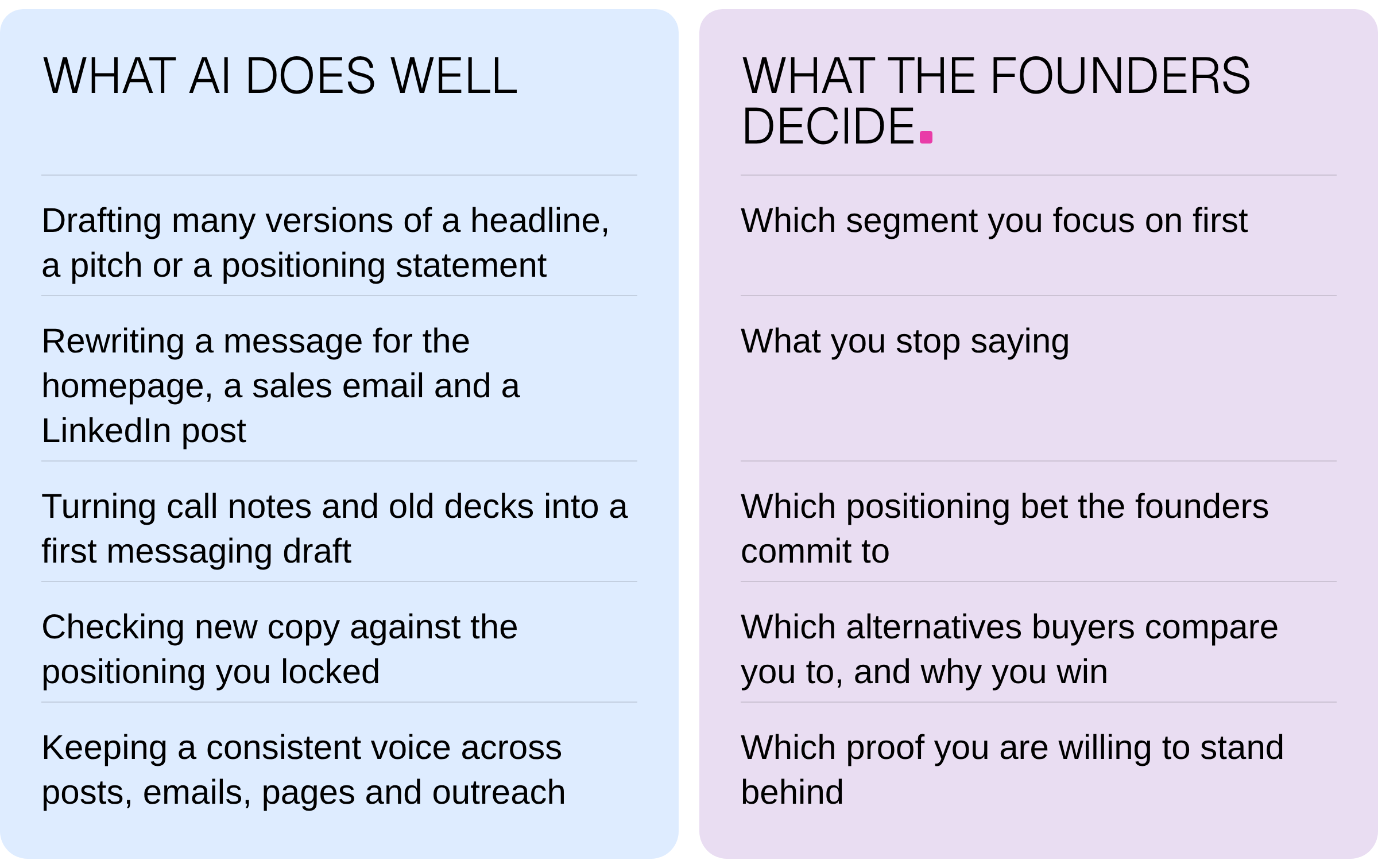
Once the decisions are made, AI is fast and useful at the work downstream: drafting versions of a line, rewriting one message for a homepage, a sales email and a LinkedIn post, and checking new copy against what you locked. The more of your positioning it can read, the less generic it gets.
The positioning process I always ran used to take about three months. With my Positioning Builder it takes three weeks. AI does a lot of the drafting and sorting in that process. The decisions still get made in a room with the founders: in session 1 we score your segments with the founders and stakeholders and pick the one you focus on.
| What AI does well | What the founders have to decide |
|---|---|
| Drafting many versions of a headline, a pitch or a positioning statement | Which segment you focus on first |
| Rewriting a message for the homepage, a sales email and a LinkedIn post | What you stop saying |
| Turning call notes and old decks into a first messaging draft | Which positioning bet the founders commit to |
| Checking new copy against the positioning you locked | Which alternatives buyers compare you to, and why you win |
| Keeping a consistent voice across posts, emails, pages and outreach | Which proof you are willing to stand behind |
Why does AI-written positioning sound like everyone else's?
Because a model with no positioning to read falls back on the average of your category. Give it "AI platform for X" and it hands back the claims your competitors already make, in cleaner sentences.
Founders see it. One wrote on Reddit this summer: "Ungrounded models invent features and write the same beige listicle as everyone else." What fixes it is giving the model your decisions every time, without retyping them.
How do I give ChatGPT or Claude context about my company?
Write your positioning down once, in a few plain text files, and give those files to the AI at the start of every piece of work. Keep them in one place the team owns, and update them when a decision changes, so nobody has to re-explain the company in each chat.
There's no sense in teaching Claude your positioning and messaging from scratch every time you want a LinkedIn post, an email sequence for sales or a press release. I keep the files as plain .md text, which any AI tool can read, so you can switch tools without rewriting anything. Attach them to a chat, keep them in a project, or keep them in a repository. For clients, I've packed the files into their own GitHub repository and connected their team's Claude Code to it.
The order matters:
- Lock the decisions. Segment, competitive alternatives, why you win. If the founders don't agree yet, stop here.
- Write each decision into its own file. One answer per question, written so a new hire could repeat it.
- Store the files where the team owns them, in a shared folder or repository, not in one person's chat history.
- Start every AI task from the files. Posts, emails, pages, outreach, sales decks.
- Connect the AI tool to where the work happens. Your CRM, analytics, calendar and call recordings, so it writes from real deals and real numbers, not only from the files.
- Change the files when a decision changes. Every tool that reads them picks up the change, with no re-briefing.
What goes in a company context file for AI?
The marketing brain in my sprint has five files: positioning, messaging, voice, proof and objections. Each one holds decisions, so the AI reads one answer instead of five options.
| File | What goes in it |
|---|---|
| positioning.md | What you sell, to whom and why you win, agreed by the founders, in one page everyone can repeat |
| messaging.md | The elevator pitch, the homepage hero and the message for each buyer |
| voice-dna.md | How you sound: phrases you use, phrases you never use, how you open and close |
| proof-points.md | The numbers, quotes and results you can stand behind, each with its source |
| objections.md | What buyers push back on, and how you answer |
Leave out brainstorms, rejected taglines and old decks. Anything you give the model can end up in the copy.
What is the marketing brain?
The marketing brain is your positioning, messaging, voice and proof in one place your team owns, so every AI tool and automation starts from it.
Copy and paste it into any go-to-market automation or AI tool you already use, and the posts, emails, pages and outreach it produces start from your positioning instead of sounding like everyone else's. A strategy deck gets presented once and filed. The marketing brain gets read by every tool, every time it writes. Connect it to your CRM, analytics and call recordings, and it stays current: new wins, objections and numbers flow back into it.
What does a marketing brain look like when it runs?
I run Yalla Marketing on one. My AI marketing system has 17 agents, from a Researcher to a Gatekeeper, and every one of them reads the same files about me, my audience and what we've learned before it writes a word.
This article went through four of them. A Researcher found the angle in my own files, a Copywriter drafted it, a Proof Keeper checked every claim against its source and cut the ones that had none, and a Gatekeeper checked the voice. Then I edited it. None of them had to be told who Yalla Marketing sells to.
I build the same thing for clients, positioning first.
Should you build your marketing brain yourself or get help?
Build it yourself if the founders already agree on who you sell to, what you're compared to and why you win. Then the job is writing it down, and AI helps with that. Get help if they don't agree, because AI will write whichever version it gets.
| If this is true | Do this first |
|---|---|
| The founders pitch the company the same way, and the homepage lands | Write the five files yourself. Use AI to draft them from your best sales calls and decks. |
| You rewrite the homepage every quarter, and it still doesn't land | Make the positioning decision before the next rewrite. |
| You pitch it one way, your co-founder pitches it another | Settle the positioning with both of you in the room, then write the files. |
| AI writes your posts, and they sound like everyone else's | Check what the AI reads. If there is no positioning file, start there. |
The middle two rows are what my 3-week positioning sprint is for. Three two-hour sessions, one a week, with the founders in the room. Session 1 picks who you are for, session 2 sets why you win, and in session 3 we review the messaging and website copy together and lock what ships. I draft in my Positioning Builder in between, and after session 3 you get your marketing brain in one folder, ready to plug into your AI tools.